

Why do we support the club we support?
Factball #12


On a cold December night in 1998, the clinking of cutlery echoed in the main hall, as is customary at the gatherings of a Portuguese family. Well-composed dishes with the best that gastronomy can provide, glasses full of regional red wine, and a side table with desserts and "digestive" whiskey waiting to finish the feast...
The stage was set for another night of happiness for a Portuguese family, in the beautiful city of Tomar, in central Portugal.
Then, in yet another moment of “evangelization” by an avid Benfica supporter, the night's big question arose, addressed to a 4-year-old child, full of his certainties as firm as a house of cards.
- Hey boy, when are you going to root for Benfica and leave Porto? Benfica is the biggest club in Portugal. Have you paid attention to the grandeur of Estádio da Luz? And have you noticed that your blood is red and not blue? And, don't you know that the eagle is a majestic animal that reigns in the skies and dragons don't even exist, they are a lie?
- Yes, but Porto wins; I even went to the Antas stadium; my blood is red, but the sky is blue; and dragons spit fire and kill all eagles...
- Yes, but have you noticed that you are the only one in your family who supports FC Porto? I'm a Benfica supporter, your father is a Benfica supporter, your mother too, your sister too, your godparents the same, and all your cousins too… Don't you think you should also root for Benfica?
The child did not seem convinced, so it was necessary to launch the ultimate argument:
- Look, even Saint Anthony roots for Benfica!
This Saint Anthony “trap” is not innocent, as there was a statuette of considerable dimensions of the patron saint of Lisbon and Padua in the house's entrance hall.
That question must have been hovering in the head of the young football lover, who, a few days later, was “caught” by his mother asking the statuette if it really also supported Benfica.
Some response must have been given, even if not vocally. This is the story of how another Benfica fan was “born”, who wasn't a Benfica fan from birth, but from the moment he dared to question the meaning of his choices.
Whether you support your club because of the influence of your father or your older cousin from the big city, because of recent victories and titles won, or even because of divine intervention, the truth is that all reasons are valid, as long as you don't walk around changing clubs every week.
This led me to try to understand the different reasons for supporting the clubs we support and what this could mean for football clubs in their strategies for attracting and retaining members.
The reasons
To go deep into this issue, we review an extensive study of the Association of European Clubs, dated 2020, which had a sample of more than 14,000 people, 2,000 from each of the analyzed markets: United Kingdom, Spain, Germany, Poland, Netherlands, India, and Brazil.
When asked about the reasons for supporting their favorite football club, these were the answers obtained:
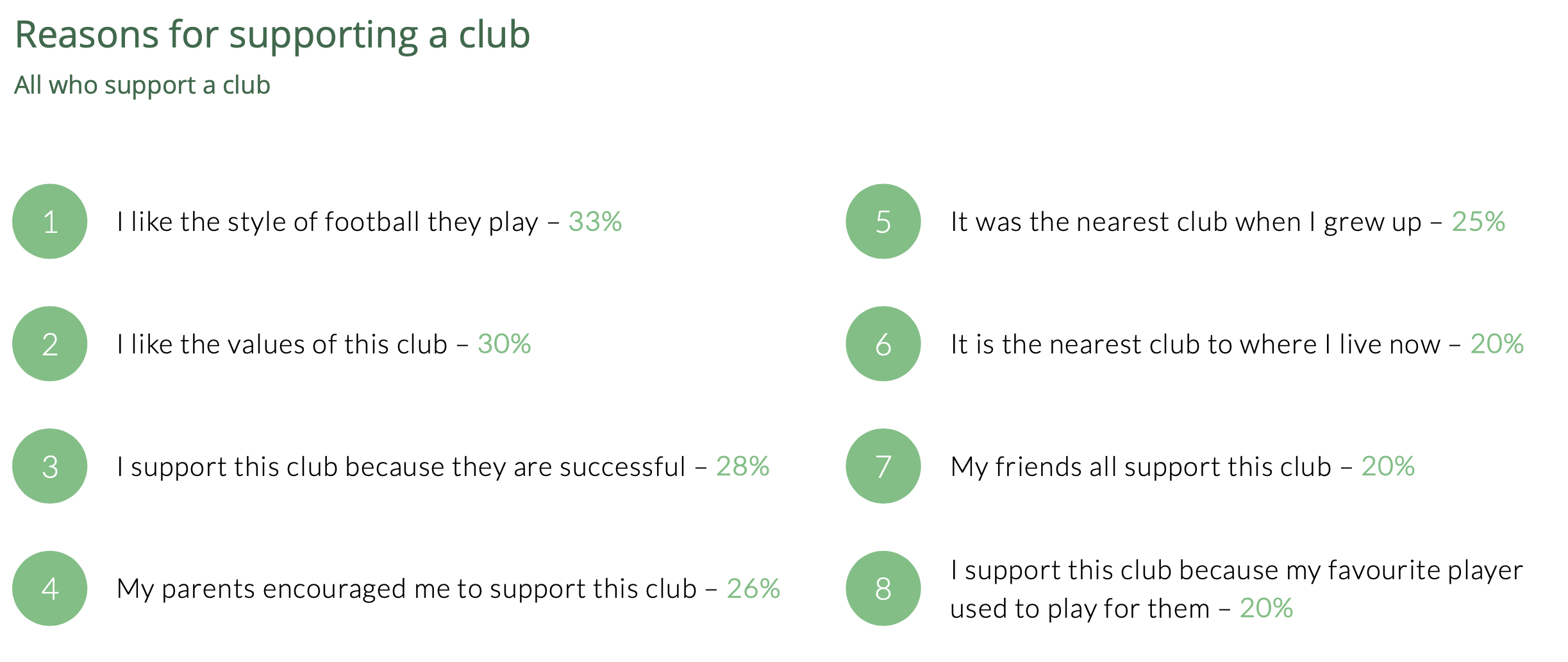
When asking younger people aged between 8 and 12 years old, three reasons outweigh all the others: the club's success (44%), parental influence (37%), and it being the team they use in video games (33%).
This report also tells us that the importance of geographical proximity to the club increases with the age of the supporter, with 22% in the 16 to 24 age group and 31% in the 55 to 64 age group.
The study further shows that the partner’s influence is greater among females, with 21% of female football fans stating that their partner's choice is a crucial factor, as opposed to just 6% of men.
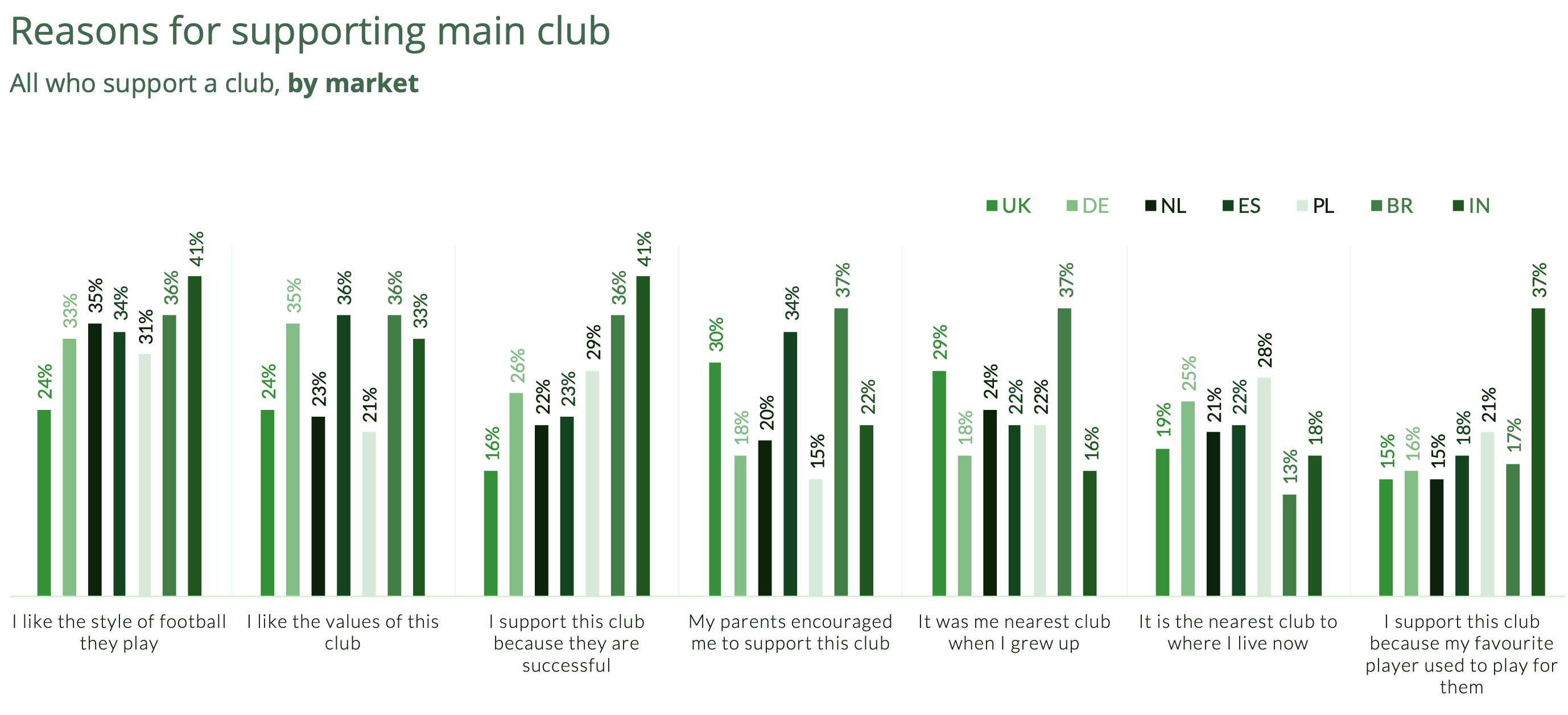
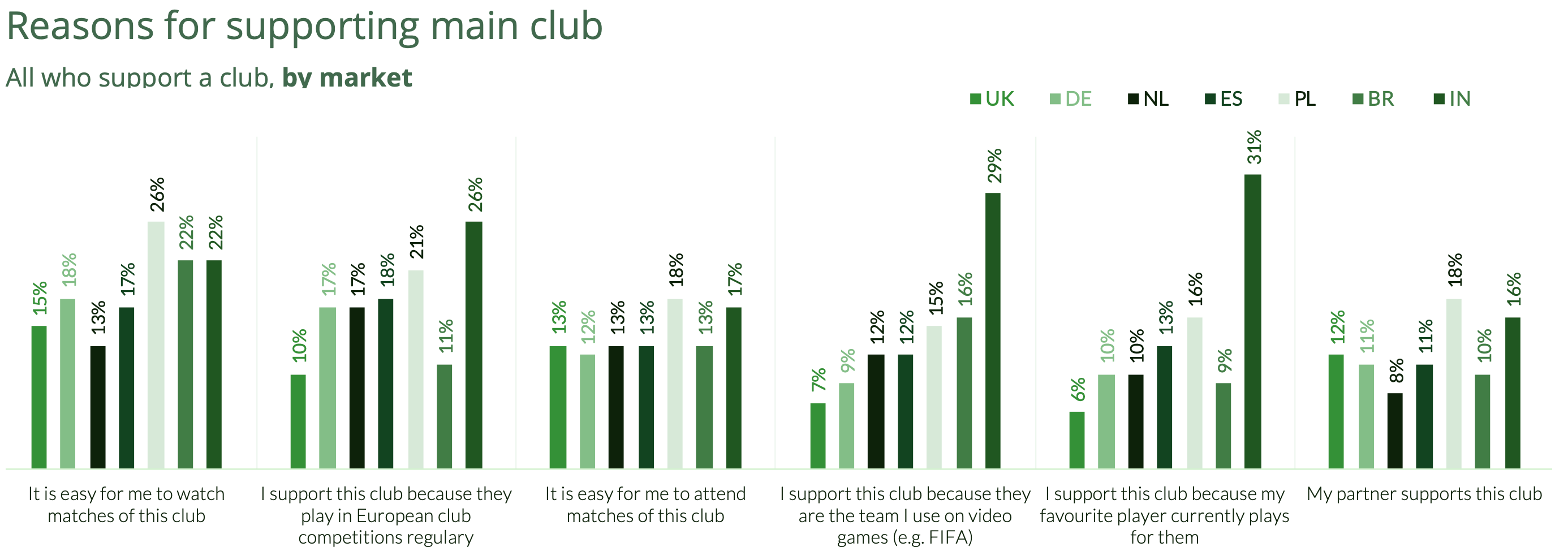
In terms of the analyzed markets, the main reason for each one is:
United Kingdom - “My parents encouraged me to support this club” - 30%;
Germany - "I like the values of the club" - 35%;
Netherlands - "I like the style of football that they play" - 35%;
Spain - "I like the values of the club" - 36%;
Poland - "I like the style of football that they play" - 31%;
Brazil - “My parents encouraged me to support this club” - 37%;
India - "I like the style of football that they play" and "I support this club because they are successful" - 41%;
Likewise, we can see that the dynamics are slightly different in the only market where football is not the country's favorite sport (India). Of the reasons that are predominant in other markets, several do not have as much weight in this Asian country, and the opposite is also true. The influence of parents and geographical proximity fall into the background, while the power of video games and players has a much greater weight.
Conclusion
Having the facts in our possession now, everything becomes easier to analyze.
One of the first deductions we can make and one that will probably come as a surprise to supporters of dominant clubs in their leagues: winning isn't everything. I know that this is the goal of professional football, and that is what athletes play and coaches train for, but “the fans” tell us that if there is an attractive style of play and the club is faithful to its values, it can perfectly fulfill their needs without necessarily winning silverware.
In terms of the markets analyzed here, there are also several practical conclusions that we can draw.
In the United Kingdom, participation in European competitions and sporting success represent 10% and 16%, relatively low values. On the other hand, geographical proximity in youth and the influence of parents have a weight of 30%. This can probably be seen as one of the great reasons for the success of the English leagues. Support for the different clubs is well divided, which means that many clubs can fill their stadiums and have a vast fan base that wants to buy their merchandise.
In Germany, the culture of “stadium attendance” seems clear, as current proximity outweighs geographical proximity in youth and parental influence. Added to this, the style of play is one of the main reasons for supporting a club, which seems to privilege the spectacle to the detriment of results.
In the Netherlands, the style of play is the main motive in force in the country, with more than a third of supporters choosing it. Perhaps because the supremacy in terms of titles is concentrated in two clubs (in the last 50 seasons, only 8 times the champion was not Ajax or PSV), fans look for a differentiating factor in their teams and need them to practice attractive football at the expense of worrying about winning titles.
In Spain, parental influence, club values, and style of play are by far the biggest drivers of support. So it could signify that focusing on the community should be a top priority for every club.
In Poland, the current geographical proximity and the ease of seeing the team's games indicate that, as in Germany, there is a strong component of stadium attendance. (Is it because they are two of the few countries in this study that allow alcohol in stadiums? This might be a topic for another issue of Factball.)
Brazil is the market where geographical proximity in youth is most relevant, but the top 5 reasons assume similar weights. However, adding to this the fact that “playing in European competitions” is not relevant for Brazilians, we can infer that the domestic football market is the predominant one, which, for those who follow football, is not surprising.
Finally, in India, there are clear signs that fans mainly support foreign clubs since geographical proximity is not very relevant, and there is an extra weight on video games and world football stars. This is also one of the countries where there is a more significant effort by the various English Premier League clubs in trying to “raise” fans.
This market-by-market analysis could help football clubs, and especially leagues, to adjust their communication and marketing strategies, as well as to provide as much value as possible to their supporters. For example, where winning is more relevant, the competitiveness of a championship should be communicated, and how small clubs have a real chance of winning against the bigger ones should be highlighted. On the other hand, if the most important thing is the family ties that football has created, this should be promoted, with family stands, more affordable tickets, and campaigns for new youth members, for example. Of course, to be done most efficiently and effectively, this will have to be analyzed club by club (which, in many of them, is already a reality).
Just as there are many reasons to support a club, there may be, in the future, a league that focuses on each of them purposely to attract new fans, which worries the high ranks of our game so much. I hope, however, that we never forget football's origins and that football remains a game.
Best regards and an impossible free-kick from Roberto Carlos,
João Francisco
Extra Time

Fact 🔍
John Terry scored more Premier League goals for Chelsea than Andres Iniesta scored La Liga goals for Barcelona.
Podcast 🎧
Tweet 🐦
